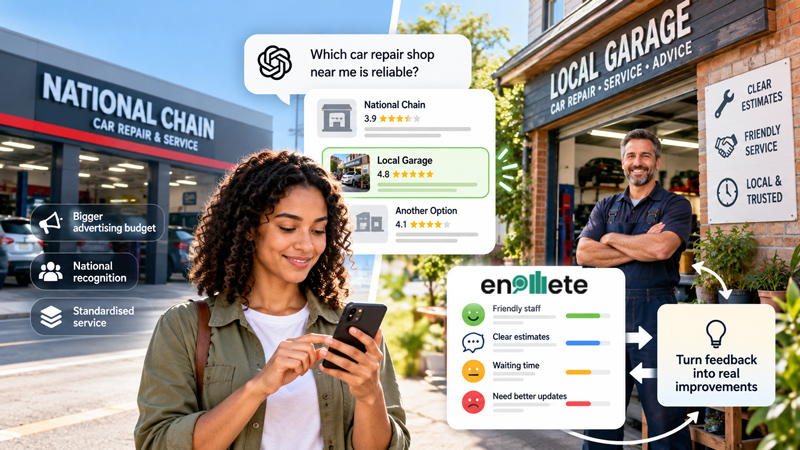
A customer asks an AI assistant for a reliable repair shop nearby. A familiar national chain might seem like the obvious recommendation. But the customer is looking for a good local experience, not simply a name they recognise.
That creates an opportunity for independent businesses. A big brand can spend more on advertising. A local business can often learn what customers value, fix what frustrates them and describe its services with greater local detail.
The transcript behind this article makes a useful point: national recognition does not guarantee that an individual location will be recommended. Its specific claims about how often ChatGPT recommends chains, or the rating supposedly required to appear, should not be treated as universal rules. AI answers can vary by question, location, available sources and time. The practical lesson is stronger without those promises: make your business easy to understand online, and make the experience customers actually receive worth talking about.
The belief that keeps small businesses playing the wrong game
When a large competitor opens nearby, the instinct is often to imitate its marketing: publish more, buy more ads or offer a bigger discount.
That can be an expensive contest for a small business. It also misses an advantage a national brand cannot easily reproduce across every branch: direct access to the people who use your service.
The more useful question is not, “How do we look as big as they do?” It is:
“What do customers choose us for, where do we disappoint them, and how quickly can we improve?”
A local business that can answer those questions has something more useful than a generic marketing slogan. It has specific knowledge of its customers and a way to turn that knowledge into a better experience.
AI makes clear, credible local information more valuable
People can now ask conversational questions instead of searching for a category alone: “Which gym nearby is welcoming for beginners?” or “Where can I get my car repaired with a clear estimate?”
ChatGPT Search can use information from the web and provide links to sources. Google says its local results are mainly influenced by relevance, distance and how well known a business is; complete business information and reviews can help customers find and evaluate it. Neither platform promises that a survey, a particular star rating or a few changes to a listing will secure a recommendation. OpenAI Help Center
For a local owner, this creates two related jobs:
- Make the business clear to someone researching it. Keep services, location, opening hours and other public information accurate. Give customers a truthful picture of what to expect.
- Improve the experience behind that information. Learn whether the service customers receive matches what you promise.
Enquete.com helps with the second job. Customer feedback can reveal what is working and what needs to change. That learning can then inform how you describe your business publicly, without treating private survey responses as public endorsements.
Listening only to vocal customers leaves gaps
Imagine two independent garages competing with a national repair chain.
The first garage believes customers value its friendly staff. It advertises “personal service” because the owner regularly hears praise at the counter.
The second asks customers three questions after collection:
- Was the repair and final price explained clearly?
- What made the process easy or difficult?
- What should we improve before your next visit?
The answers show that customers do value the staff, but they care even more about receiving a clear estimate before work begins. Several also mention that they were unsure when their cars would be ready.
Now the garage has a practical advantage. It can improve its estimate and update process, then check whether later customers notice. It can also describe those parts of its service accurately on its website. The advantage comes from learning and acting, rather than merely claiming to be more personal than a chain.
Turn feedback into a local advantage
A small business does not need a large research programme. It needs a repeatable process that leads to decisions.
1. Ask at the right moment
Ask about an experience while customers can still describe it clearly. A restaurant might ask shortly after a visit. A repair shop might ask after collection. A gym could ask new members about their first visit, then ask again after they have had time to use the facilities.
The timing should match the question. A first day survey can reveal a confusing introduction; it cannot tell you whether someone will still enjoy their membership six months later.
2. Keep the survey short and specific
“Were you satisfied?” can be useful, but it rarely tells you what to change on its own. Pair a rating with a focused follow-up, such as “What was the main reason for your answer?”
Ask about the parts of the experience your team can influence: booking, communication, waiting time, clarity, service or follow-up. Avoid asking for data simply because it might be interesting someday.
3. Look for patterns, then assign an action
One comment may need an individual response. Repeated comments may point to a process problem. If several customers mention confusing directions, update the arrival instructions. If they mention slow callbacks, decide who owns them and set a realistic response target.
Choose a change, give someone responsibility for it and check subsequent feedback. A dashboard is useful only when it helps somebody decide what to do.
4. Keep your public claims grounded
Feedback may reveal that customers particularly value flexible appointments or clear explanations. If those are reliable strengths, describe them plainly on your website and business profile.
Keep private feedback separate from public reviews. Do not present survey comments as public testimonials without the customer’s permission. Respond to public reviews through the platform where they were posted, and give customers an honest way to share their experiences.
How Enquete.com helps put this into practice
Enquete.com gives local businesses a way to collect structured feedback without building a process from scratch. You can create a survey with its AI Survey Creator, edit the questions to fit your business and share it by link, email or QR code. That makes it possible to ask after an appointment, include a survey link in a follow-up message or place a QR code where customers can use it. (See the documentation on how to create an AI survey.)
For example, a local gym could start with a short survey for new members:
- How easy was it to get started?
- Did you know which facilities or classes suited your goals?
- What, if anything, made your first visit uncomfortable?
- What could we do to improve your next visit?
If several beginners say they did not know where to go, the gym could improve its welcome message or first visit guidance. It could then ask the next group of new members the same questions to see whether the problem persists.
That is a credible use of AI and surveys together: AI can help the business create the survey faster, while customers provide the evidence needed to make a better decision. Enquete.com does not control which businesses an AI assistant recommends. Its role is to help you understand and improve the experience those recommendations are meant to help people find.
Start with one customer journey
Choose one moment where customers may be having an experience you cannot currently see: a first visit, a completed service or a recent purchase.
Create a short survey, collect responses for several weeks and identify one issue you can fix. Make the change, then ask the next customers whether their experience improved. At the same time, check that your public business information accurately describes the service you provide.
Large companies have scale. A local business can compete through attention, speed and a more relevant experience—but only when it listens systematically enough to know what to improve. Create your first customer feedback survey with Enquete.com and start with the moment that matters most to your customers. Enquete.com