Your analytics dashboard can tell you a tremendous amount about customer behavior.
A customer visited your website.
They viewed the pricing page.
They opened an email.
They clicked a button.
They purchased a product.
They cancelled their subscription.
All of that information matters.
But there is one thing behavioral data often cannot tell you on its own:
Why?
Behavior Is the "What"
Imagine your analytics show:
72% of visitors leave the pricing page without purchasing.
That's useful.
But what should you change?
Maybe the price is too high.
Maybe visitors don't understand the plans.
Maybe they need approval from someone else.
Maybe they're comparing competitors.
Maybe they don't trust the company yet.
Maybe they simply aren't ready to buy.
The behavioral data tells you what happened.
It doesn't necessarily tell you why.
The "Why" Requires a Different Type of Data
This is where customer feedback becomes valuable.
You can ask:
What is the main reason you decided not to purchase today?
Then provide relevant choices and an optional open-text response.
Now your behavioral data has context.
Combine Observation With Explanation
Think of customer intelligence as two layers.
Behavioral data
What customers did.
Attitudinal data
What customers think, feel and say.
Neither is automatically sufficient on its own.
Suppose:
Behavior:
Customers who use Feature A are 40% more likely to renew.
That's interesting.
Now ask those customers:
What makes Feature A valuable to you?
You might discover that the feature isn't valuable for the reason your team assumed.
Perhaps it saves time.
Perhaps it makes reporting easier.
Perhaps customers use it to satisfy an internal requirement.
That difference matters.
Don't Ask Customers to Explain Everything
There is another important lesson.
Customer feedback isn't a perfect replacement for behavioral data.
People don't always remember accurately.
People may answer according to what they believe they should say.
Intent isn't always behavior.
That's why the strongest research strategy often combines both.
Instead of asking:
"Would you recommend this product?"
only, you can also examine actual usage, purchase and renewal behavior.
The goal is not to choose between analytics and surveys.
It's to connect them.
A Simple Framework
Use this framework:
1. Observe
What are customers actually doing?
2. Ask
Why do they say they're doing it?
3. Compare
Where do behavior and stated preference agree or disagree?
4. Investigate
What explains the difference?
5. Act
What should the business change?
This produces much richer customer intelligence.
Example: E-commerce
Analytics:
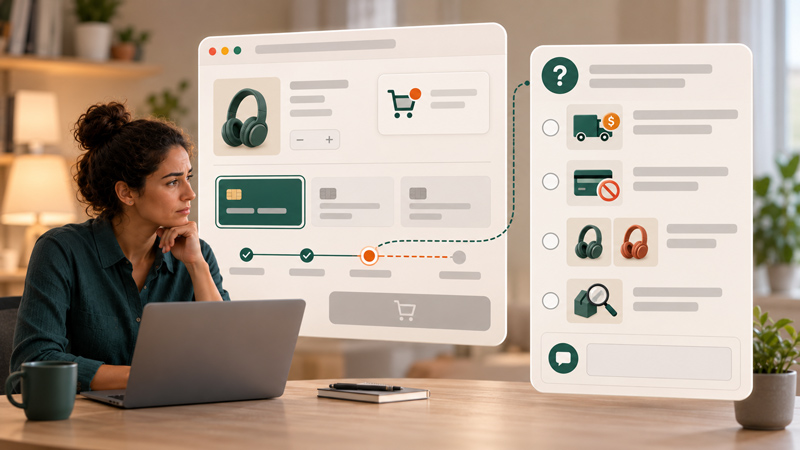
Customers frequently add Product A to their cart but don't complete checkout.
Survey:
What prevented you from completing your purchase?
Responses:
-
Shipping cost
-
Price
-
Wanted to compare alternatives
-
Payment method unavailable
-
Need more information
-
Not ready to purchase
Now your team has potential explanations to investigate.
Example: SaaS
Product analytics:
Customers who use Feature X have higher retention.
Survey:
What is the primary reason Feature X is useful to you?
You may discover:
"It gives me a report I can send directly to management."
That's a much stronger insight than simply knowing the feature is correlated with retention.
Now marketing can communicate that benefit.
Product can improve it.
Sales can demonstrate it.
Customer success can teach it.
One customer insight can influence multiple departments.
Use Enquete to Capture the Missing Layer
Enquete allows businesses to collect customer feedback through surveys and analyze responses using metrics, filters, trend reports and AI Insight.
You can also use website targeting and URL targeting to ask questions at relevant moments.
That means you can connect a behavior with a question.
For example:
A visitor spends significant time on your pricing page.
Then:
"What information would help you decide?"
That's much more useful than guessing.
The Best Customer Intelligence Uses Both
Don't ask:
"Should we use analytics or surveys?"
Ask:
"What can each source tell us?"
Analytics can reveal:
What happened.
Customer feedback can reveal:
What customers say happened and why they think it happened.
Together, they provide a much more complete picture.
The Customer Intelligence Series
- Why AI Makes Customer Feedback More Valuable, Not Less
- Stop Asking AI What Your Customers Want. Ask Your Customers.
- How to Build a Customer Learning Loop
- What Your Customers Do Isn't the Same as Why They Do It
- How to Turn Survey Responses Into Marketing Intelligence
- How Original Customer Research Can Make Your Brand More Visible in AI Search
- How to Use Customer Feedback to Improve Website Conversion
- How to Combine Behavioral Data With Customer Feedback
- Why More Marketing Data Doesn't Always Mean Better Decisions
- How to Turn Customer Surveys Into Original Research Reports