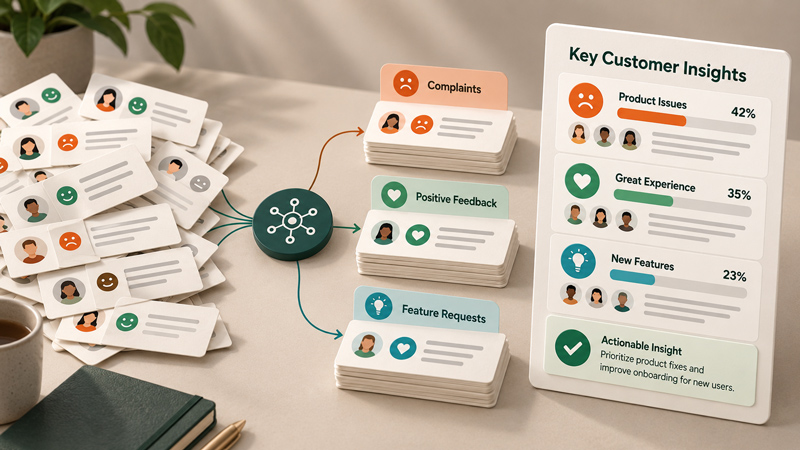
Most companies treat survey responses as a report. The survey ends, the responses are exported, someone creates a presentation the presentation is shared, then everyone moves on. That is a waste.
Your survey responses can become one of your most useful sources of marketing intelligence.
A Survey Is Not the Insight
The survey is simply the collection mechanism.
The real value lies in the information contained inside the responses.
Imagine you ask 500 customers:
Why did you choose us?
You might discover:
-
31% chose you because of ease of use
-
24% because of price
-
18% because of a specific feature
-
15% because of recommendations
-
12% for another reason
That is already useful.
But the open-ended responses may be even more valuable.
Customers may repeatedly describe your product using phrases your marketing team never considered.
Those phrases can influence your messaging.
Turn Responses Into Five Types of Intelligence
1. Customer Motivation
Why did customers choose you?
This can reveal the real drivers behind purchase decisions.
2. Customer Objections
What almost stopped them?
This can reveal what your sales and marketing need to address.
3. Customer Language
How do customers describe the problem?
This can improve your website and advertising copy.
4. Customer Priorities
What do customers value most?
This can influence product positioning.
5. Customer Opportunities
What do customers wish existed?
This can generate product and campaign ideas.
Example: Improving Your Homepage
Suppose your homepage currently says:
"Powerful customer feedback platform for modern businesses."
That sounds reasonable.
But your survey responses repeatedly contain:
"I needed something simple enough to create a survey in a few minutes."
Now you have a customer-generated positioning opportunity.
Your marketing team can test:
"Create a professional survey in minutes."
The difference is subtle.
But the second statement is grounded in customer language.
Segment Your Responses
Not every customer is the same.
Suppose you survey:
-
Marketing teams
-
HR teams
-
Researchers
-
Trainers
-
Students
If you combine everyone into one average, you may lose important differences.
Marketing teams may prioritize customer research.
HR teams may prioritize employee feedback.
Trainers may prioritize evaluation.
Researchers may prioritize advanced analysis.
Segmentation makes your feedback more useful.
Enquete provides response filtering and advanced filters, allowing teams to investigate responses by relevant criteria.
Turn Customer Feedback Into Campaign Ideas
Suppose customers tell you:
"We use the product after every training session."
That's not merely feedback.
That's a marketing insight.
You can build content around:
How to collect feedback after every training session.
Then create:
-
Blog posts
-
Templates
-
Case studies
-
Email campaigns
-
LinkedIn posts
-
Videos
-
Webinars
One customer insight can generate an entire content cluster.
Turn Survey Results Into Proof
Suppose 82% of customers say a particular feature saves them time.
That statistic can become:
-
A blog statistic
-
A social post
-
A sales presentation
-
A case-study element
-
A landing-page proof point
You should always represent your research accurately and provide appropriate context, but original customer data can make marketing much more concrete.
Use AI to Accelerate Analysis
Large surveys can produce hundreds or thousands of responses.
Manually identifying themes becomes increasingly difficult.
AI-assisted analysis can help surface:
-
Common themes
-
Frequently mentioned topics
-
Positive and negative patterns
-
Potential anomalies
-
Important customer comments
Enquete's AI Insight Report is designed to help turn survey responses into insights, while its analytics capabilities provide additional ways to filter and examine results.
Build a Marketing Intelligence Workflow
Try this:
Step 1: Ask customers a focused question.
Step 2: Collect responses.
Step 3: Segment the responses.
Step 4: Identify recurring themes.
Step 5: Extract customer language.
Step 6: Turn insights into hypotheses.
Step 7: Create marketing assets.
Step 8: Test the message.
Step 9: Collect feedback again.
Now your survey isn't the end of the marketing process.
It is the beginning.
The Hidden Content Engine
One good survey can produce:
Research
↓
Insights
↓
Marketing claims
↓
Content
↓
Campaigns
↓
Customer conversations
↓
More research
That is a marketing intelligence loop.
And it is much more valuable than simply downloading an Excel file after your survey closes.
The Customer Intelligence Series
- Why AI Makes Customer Feedback More Valuable, Not Less
- Stop Asking AI What Your Customers Want. Ask Your Customers.
- How to Build a Customer Learning Loop
- What Your Customers Do Isn't the Same as Why They Do It
- How to Turn Survey Responses Into Marketing Intelligence
- How Original Customer Research Can Make Your Brand More Visible in AI Search
- How to Use Customer Feedback to Improve Website Conversion
- How to Combine Behavioral Data With Customer Feedback
- Why More Marketing Data Doesn't Always Mean Better Decisions
- How to Turn Customer Surveys Into Original Research Reports