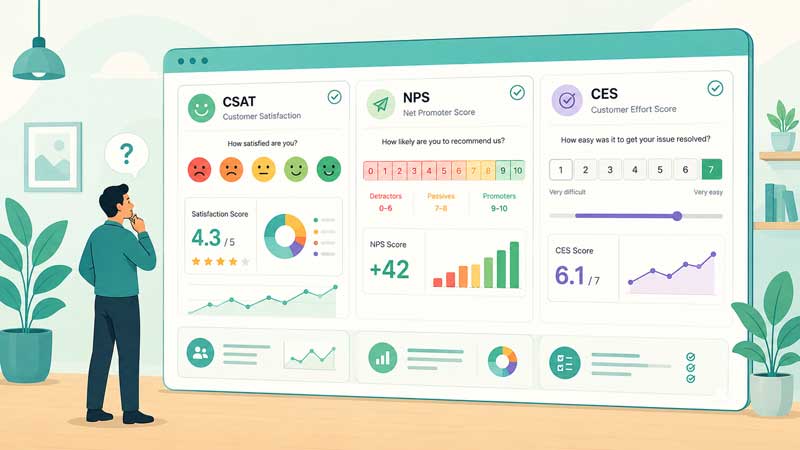
If you want to understand how customers feel about your business, you need more than a general sense that people are happy or unhappy. You need a metric that helps you measure experience in a way that supports better decisions. This is where many teams run into confusion. They hear about Customer Satisfaction, Net Promoter Score, and Customer Effort Score, then assume these metrics do roughly the same thing. In practice, they do not. Each one measures a different dimension of the customer experience, and each one is useful for a different type of business question.
This matters because the value of a survey metric does not come from how popular it is. It comes from how well it matches the decision you are trying to make. If you use the wrong metric, you may collect data that looks useful on a dashboard but tells you very little about what to improve. That is why you should not begin with the question, “Which metric is best?” You should begin with, “What exactly am I trying to understand, and what will I do with the answer?” Once you think that way, the difference between CSAT, NPS, and CES becomes much clearer.
Why Choosing the Right Metric Matters
The choice of metric shapes the kind of feedback you collect and the kind of action you can take afterward. If your goal is to understand whether a recent support interaction met expectations, you need a different measure than if your goal is to assess long-term customer loyalty. If you want to know whether customers found a process easy, that requires yet another angle. Using one metric for every situation may feel simple, but it often produces vague insight and weak follow-up decisions.
When teams choose a metric without a clear purpose, they often end up tracking numbers because those numbers are familiar, not because they are useful. A dashboard may show movement over time, but that movement may not reflect the real experience you need to improve. This creates a false sense of measurement maturity. You appear data-driven, but the metric is not tied closely enough to the operational question behind it. Choosing the right metric helps you avoid this problem and makes your feedback program far more actionable.
What Is Customer Satisfaction (CSAT)?
Customer Satisfaction, often shortened to CSAT, measures how satisfied a customer is with a particular experience, interaction, product, or service. It is usually asked in a direct way, such as “How satisfied were you with your experience?” followed by a rating scale. The strength of CSAT lies in its clarity. It gives you an immediate view of how people felt about a specific touchpoint, and it is relatively easy for respondents to understand and answer.
You should think of CSAT as a short-range experience measure. It works especially well when you want to evaluate recent interactions, such as a support conversation, a delivery experience, a product purchase, or a training session. It tells you whether the customer felt that the experience met expectations. That makes it highly practical for teams that need direct operational feedback. However, satisfaction alone does not always tell you how strongly that experience affects loyalty, future behavior, or advocacy. A customer may say they were satisfied without becoming especially loyal or enthusiastic about your brand.
What Is Net Promoter Score (NPS)?
Net Promoter Score, or NPS, measures the likelihood that a customer would recommend your company, product, or service to others. The standard format asks respondents to rate that likelihood on a scale from 0 to 10. Based on their answer, respondents are grouped into three categories: Promoters, who score 9 or 10; Passives, who score 7 or 8; and Detractors, who score between 0 and 6. The final score is calculated by subtracting the percentage of Detractors from the percentage of Promoters.
NPS is designed to act as a signal of loyalty and advocacy rather than immediate satisfaction with a single event. That is why many businesses use it at a relationship level instead of after small transactional moments. If you want to understand how customers feel about your brand more broadly, NPS can be useful. It is also widely recognized, which makes it attractive for benchmarking and executive reporting. At the same time, its simplicity is also its limitation. Knowing whether someone is likely to recommend you does not always explain why they feel that way or what exact part of the experience needs improvement. NPS is strongest when it is paired with follow-up questions and interpreted as part of a broader feedback system.
What Is Customer Effort Score (CES)?
Customer Effort Score, or CES, measures how easy or difficult it was for a customer to complete a task or resolve an issue. A typical question might ask whether the company made it easy to solve a problem, complete a request, or achieve a goal. This makes CES especially valuable when you want to evaluate friction in the customer journey.
You should use CES when ease is central to the experience. This often applies in support, onboarding, self-service, account changes, returns, cancellations, claims, and other service interactions where customers are trying to get something done. In these cases, satisfaction alone may not tell you enough. A customer might say they were satisfied with a polite support representative while still finding the process slow, complicated, or frustrating. CES helps you isolate that practical dimension. It is particularly useful when your goal is to reduce friction, improve process design, and make customer interactions more effortless.
The Strengths and Weaknesses of Each Metric
Each metric has real value, but each one also has limits that you should understand before using it. CSAT is strong when you want immediate, touchpoint-specific feedback. It is simple, direct, and easy to act on for service teams, product teams, and operational managers. Its weakness is that satisfaction can be influenced by expectations, mood, or context, and it does not always predict long-term loyalty very well.
NPS is strong when you want a broad signal of brand loyalty and advocacy. It is widely known, easy to communicate internally, and often useful for trend reporting or benchmarking. But it can also be too broad if your real question is operational. A low NPS tells you there may be a problem, but it does not tell you exactly where that problem sits. If you rely on it too heavily without qualitative explanation or supporting metrics, it can become more symbolic than practical.
CES is strong when you want to understand whether customers had to work too hard to achieve something. It is highly actionable in service design and support contexts because it points toward friction and process improvement. However, it is narrower than the other two metrics. It is not meant to measure brand loyalty, emotional satisfaction, or overall relationship strength. It is best used when effort is the key issue you want to investigate.
Which Metric Fits Which Business Goal
If your goal is to measure the quality of a recent interaction, CSAT is often the most suitable choice. For example, after a support ticket, product demo, delivery experience, or training session, you may want to know whether the customer felt satisfied with that particular moment. CSAT works well here because it captures immediate perception and can be tracked at the level where teams can make practical improvements quickly.
If your goal is to understand loyalty, retention risk, or long-term brand perception, NPS is usually more appropriate. You might use it quarterly, biannually, or at key relationship moments to assess how customers feel about staying with you and recommending you. It is useful when you want to step back from individual touchpoints and look at the bigger picture of the customer relationship.
If your goal is to uncover friction, especially in a service process, CES is likely the better option. For example, if customers are contacting support, trying to complete onboarding, updating account information, or navigating a return process, you want to know whether the experience felt easy. In those moments, ease is often more actionable than general satisfaction or recommendation intent. If you reduce effort, you often improve both satisfaction and retention indirectly.
Measuring Support, Onboarding, and Service Interactions
Support teams often default to CSAT because it is familiar and easy to deploy after each case. That is a reasonable starting point if your main question is whether the customer felt satisfied with the help they received. But if the deeper concern is whether customers are struggling too much before the issue is resolved, CES may be more revealing. A support interaction can feel friendly while still being unnecessarily difficult. In that case, effort tells you something satisfaction may hide.
The same logic applies to onboarding and service journeys. If you want to know whether a new customer felt good about the onboarding experience overall, CSAT can help. But if you want to identify obstacles in setup, implementation, or learning, CES often gives you more diagnostic value. You should think carefully about whether your business problem is emotional evaluation or process friction, because the answer determines which metric will serve you better.
Can You Use More Than One Metric Together?
Yes, but only when the combination is intentional. Using multiple metrics can help you understand experience from different angles. For example, you may use CSAT after specific interactions and NPS periodically to track the broader customer relationship. That setup can work well because the two measures serve different purposes and operate at different levels.
Problems begin when teams combine metrics without a clear structure. If you ask CSAT, NPS, and CES too often or in the same context without a reason, the survey becomes heavier and the interpretation becomes messy. You may collect more numbers but understand less. The point is not to measure everything at once. The point is to choose the right measure for the right moment. A smaller and more disciplined measurement strategy usually produces better decisions than a more crowded one.
How to Choose the Right Metric for Your Organization
The best way to choose is to start with the decision, not the metric. Ask yourself what you are trying to learn and what action you want the results to support. If you need to improve a specific interaction, CSAT is often useful. If you want to understand loyalty at a broader level, NPS may be the better fit. If you are trying to remove friction from a customer process, CES is likely the most relevant.
You should also consider who will use the results. Operational teams often need a metric that helps them improve specific experiences quickly. Leadership teams may want a broader relationship indicator. Product and service teams may need a friction-focused metric to refine workflows. When you align the metric with the user of the insight as well as the business goal, your survey program becomes more practical and easier to maintain.
Common Mistakes Teams Make
One common mistake is using NPS for everything simply because it is popular. That often leads to overly broad measurement and weak diagnosis. Another mistake is treating CSAT as a loyalty measure, even though it is usually better suited to specific interactions. Teams also make errors when they compare scores across contexts that are not truly comparable. A CSAT score after a support call and an NPS score from a quarterly brand survey do not tell the same story and should not be interpreted as if they do.
Another problem is asking a metric question without any follow-up context. A number on its own rarely explains enough. If you want to act with confidence, you should usually pair the score with a short follow-up question or connect it with behavioral and operational data. That is how you move from measurement to understanding. A metric should not just tell you whether something changed. It should help you understand what that change means.
Conclusion
Customer Satisfaction, NPS, and CES are all useful, but they are not interchangeable. Each one measures a different part of the customer experience, and each one becomes powerful only when matched to a clear business goal. If you choose the metric based on what you want to improve, rather than what happens to be most famous, your survey results become much more actionable.
You do not need the most popular metric. You need the right one for the question in front of you. When you use CSAT, NPS, and CES with that level of intention, you stop collecting scores for the sake of reporting and start collecting feedback that actually helps you make better decisions.