Modern businesses have no shortage of data.
Website analytics.
CRM records.
Product analytics.
Purchase history.
Email engagement.
Support tickets.
Advertising data.
Yet many businesses still struggle to answer a simple question:
Why are customers behaving this way?
The problem isn't always a lack of data.
Sometimes it's a lack of context.
Two Types of Customer Intelligence
Think about your customer data as two broad categories.
Behavioral Data
This tells you what people do.
For example:
-
Visited pricing page
-
Opened email
-
Used feature
-
Purchased product
-
Cancelled subscription
-
Contacted support
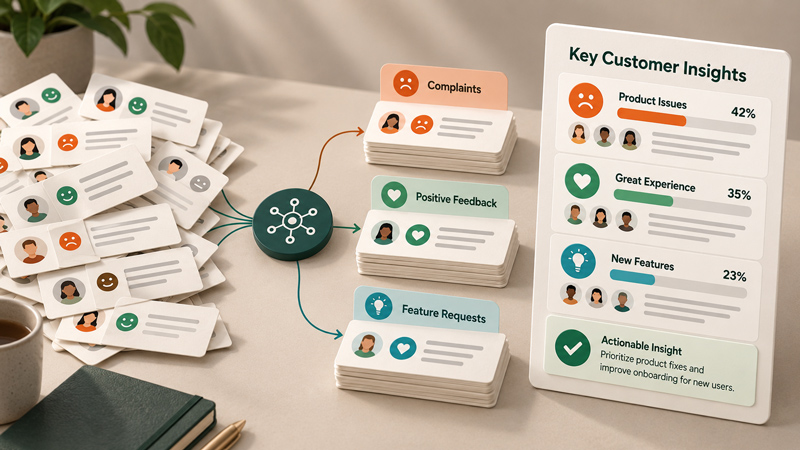
Attitudinal Data
This tells you what people say, think or feel.
For example:
-
Satisfaction
-
Motivation
-
Preference
-
Perceived value
-
Frustration
-
Intent
-
Expectations
Neither should automatically replace the other.
They answer different questions.
Example: Customers Are Cancelling
Your analytics show:
Churn increased by 15%.
That's a serious signal.
Now ask cancelled customers:
What is the primary reason you decided to cancel?
Then:
What could we have done differently?
You might discover:
-
Price
-
Missing functionality
-
Difficult onboarding
-
Low usage
-
Lack of support
-
Product no longer needed
Now you have possible explanations.
Example: Feature Adoption
Product analytics show:
Only 12% of users have adopted Feature X.
Possible explanations include:
-
They don't know it exists.
-
They don't understand it.
-
They don't need it.
-
It's difficult to use.
-
It doesn't solve an important problem.
Instead of guessing, ask.
Were you aware of Feature X?
Then:
If yes, why haven't you used it?
Now your product team has information it couldn't get from usage data alone.
Example: High Conversion but Low Retention
Imagine your marketing performs extremely well.
Lots of people sign up.
But many leave after one month.
That's a potential mismatch between:
what marketing promised
and
what customers experienced.
Survey both new and departing customers.
Ask:
What did you expect before signing up?
and:
How did the actual experience compare with your expectations?
The gap between those answers can reveal problems in positioning, onboarding or product experience.
Build a Unified Customer Picture
A useful framework is:
Behavior
What did they do?
↓
Feedback
What do they say?
↓
Context
Who are they?
↓
Comparison
Where do behavior and feedback disagree?
↓
Action
What should we investigate or change?
This is customer intelligence.
Don't Assume Survey Answers Are Perfect
Customer feedback has limitations.
People may:
-
Misremember events
-
Give socially desirable answers
-
Describe intentions rather than behavior
-
Interpret questions differently
-
Forget why they made a decision
That doesn't make surveys useless.
It means survey data becomes more valuable when interpreted alongside other evidence.
For example:
70% say they value Feature X.
Now compare that with:
Only 20% use Feature X.
That's an interesting gap.
Investigate it.
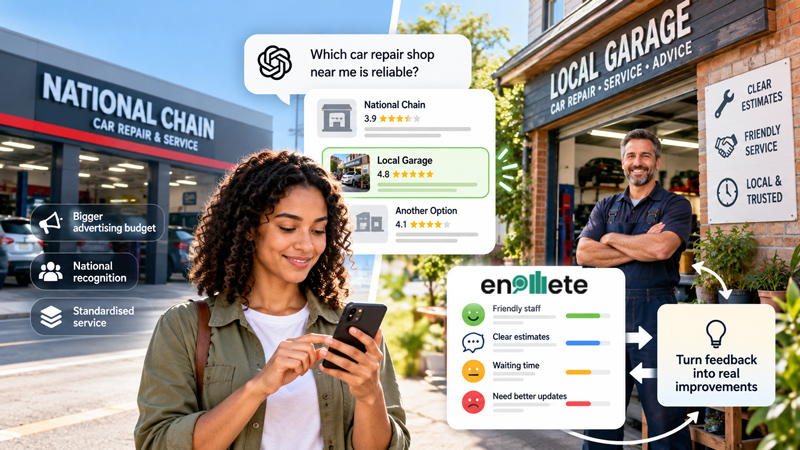
Enquete Can Provide the Feedback Layer
Enquete supports NPS, CSAT, CES, custom properties, branching, response filtering, analytics, trend reports and AI Insight.
You can also distribute surveys through email and website channels, allowing feedback to be collected at different points in the customer journey.
This makes surveys complementary to your existing analytics stack.
You don't need to replace your analytics platform.
Use customer feedback to add the layer your behavioral data doesn't provide.
The Goal Is Not More Data
It's better interpretation.
Imagine having:
10 dashboards + 100 metrics
but still asking:
"Why are customers leaving?"
Now imagine having:
10 dashboards + 100 metrics + direct customer feedback.
The second system gives you more opportunities to form and test explanations.
Combine Data Sources, Don't Isolate Them
The future of customer intelligence isn't:
Surveys versus analytics.
It's:
Surveys + analytics + CRM + support + product data.
Each source tells part of the story.
The companies that connect those perspectives can make better-informed decisions because they aren't relying on one incomplete view of the customer.
The Customer Intelligence Series
- Why AI Makes Customer Feedback More Valuable, Not Less
- Stop Asking AI What Your Customers Want. Ask Your Customers.
- How to Build a Customer Learning Loop
- What Your Customers Do Isn't the Same as Why They Do It
- How to Turn Survey Responses Into Marketing Intelligence
- How Original Customer Research Can Make Your Brand More Visible in AI Search
- How to Use Customer Feedback to Improve Website Conversion
- How to Combine Behavioral Data With Customer Feedback
- Why More Marketing Data Doesn't Always Mean Better Decisions
- How to Turn Customer Surveys Into Original Research Reports