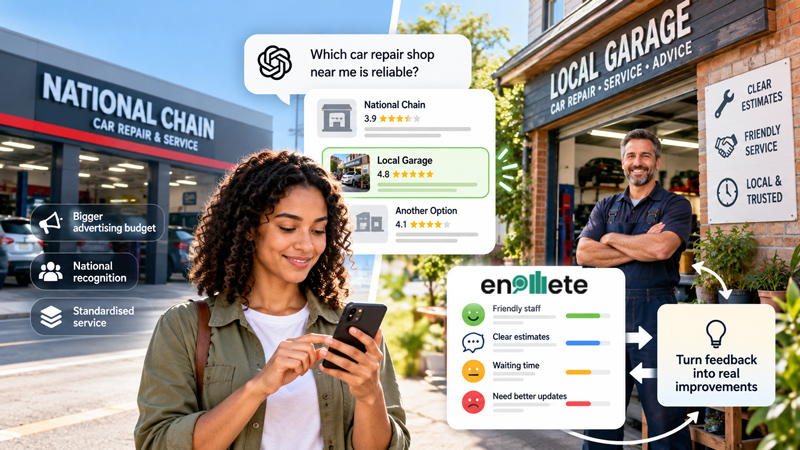
There is a strange contradiction in modern marketing.
Companies have access to more AI than ever before, yet many still don't know why customers buy from them.
They ask AI:
"What does my target audience want?"
Then they create content based on the answer.
But there is a much simpler source of information.
The people who already buy from you.
Your Customers Are Not a Prompt
AI can make a highly educated guess about your market.
Your customer can tell you about their actual experience.
Those are two very different things.
Imagine you run a SaaS company.
You ask AI:
"What features are most important to small businesses using survey software?"
You may get a list containing:
-
Analytics
-
Integrations
-
Templates
-
Automation
-
Reporting
-
AI
All reasonable.
Now ask 200 of your actual users:
"What is the biggest reason you use our product?"
You might discover that the most common answer is something completely unexpected.
Perhaps they simply want an easy way to send a professional survey without needing technical expertise.
That is information your competitors' AI prompts won't give them.
The Problem With Assumed Customer Intelligence
There are several layers between what companies think customers want and what customers actually experience.
A typical chain looks like this:
Company assumption
↓
Marketing interpretation
↓
AI-generated recommendation
↓
Campaign
↓
Customer reaction
That's a lot of room for error.
A customer-feedback loop changes the process:
Customer
↓
Feedback
↓
Analysis
↓
Decision
↓
Campaign
Now the decision starts with evidence.
Ask Better Questions
The value of customer research depends heavily on the quality of the questions.
Bad question:
"Do you like our product?"
Better:
"Which part of our product is most valuable to you?"
Even better:
"What problem were you trying to solve when you first started using our product?"
And better still for some research:
"What were you using before you started using our product?"
That last question gives you competitive and behavioral context.
Ask About the Customer's Reality
Good customer research often focuses on four areas.
1. Situation
What was happening when the customer started looking for a solution?
2. Motivation
What made them start searching?
3. Decision
Why did they choose one solution instead of another?
4. Outcome
Did the solution actually solve the problem?
Together, these questions can reveal much more than a generic satisfaction score.
Use AI After You Collect the Data
This is where AI becomes extremely powerful.
Suppose you collect 1,000 open-text responses.
Reading every response manually might take days.
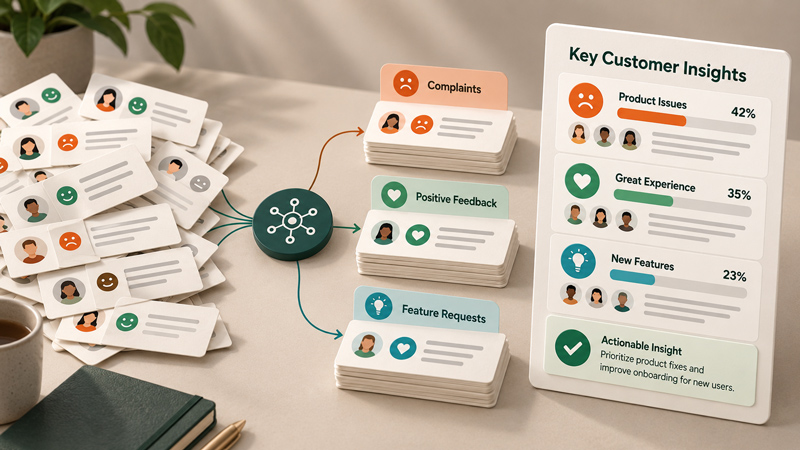
AI-assisted analysis can help you identify:
-
Frequently mentioned topics
-
Recurring complaints
-
Common use cases
-
Customer language
-
Sentiment patterns
-
Emerging requests
-
Differences between groups
The workflow becomes:
Ask customers → collect responses → analyze the responses → make decisions.
Not:
Ask AI → assume the answer → hope customers agree.
Turn Customer Language Into Marketing
One of the most valuable outputs from customer research is the language customers naturally use.
Your marketing team might describe a problem as:
"Improve organizational feedback collection."
Your customers might say:
"I need to find out what my employees actually think without spending three hours building a questionnaire."
The second statement is much closer to the customer's reality.
That language can improve:
-
Website copy
-
Advertising
-
Emails
-
Product descriptions
-
Sales presentations
-
Blog posts
-
Landing pages
Customer research can therefore improve your marketing at the messaging level.
Enquete Makes the Research Process Practical
Enquete can help you create surveys quickly, including through its AI Survey Creator, and then distribute them through multiple channels. Responses can be filtered and analyzed, with AI Insight available to help identify meaningful findings.
That means your team can move from:
"We think customers want this."
to:
"Here is what our customers told us."
That is a significant difference.
AI Should Help You Listen Better
The future isn't humans versus AI.
It's humans using AI to become better at understanding humans.
Use AI to:
-
Generate research questions
-
Analyze large response sets
-
Find patterns
-
Summarize feedback
-
Identify themes
-
Accelerate analysis
But get the underlying evidence from the people who matter.
Your customers.
The Customer Intelligence Series
- Why AI Makes Customer Feedback More Valuable, Not Less
- Stop Asking AI What Your Customers Want. Ask Your Customers.
- How to Build a Customer Learning Loop
- What Your Customers Do Isn't the Same as Why They Do It
- How to Turn Survey Responses Into Marketing Intelligence
- How Original Customer Research Can Make Your Brand More Visible in AI Search
- How to Use Customer Feedback to Improve Website Conversion
- How to Combine Behavioral Data With Customer Feedback
- Why More Marketing Data Doesn't Always Mean Better Decisions
- How to Turn Customer Surveys Into Original Research Reports