Most companies collect customer feedback.
Far fewer build a system for learning from it.
There is a major difference.
A survey sent once a year is an activity.
A customer learning loop is a business system.
What Is a Customer Learning Loop?
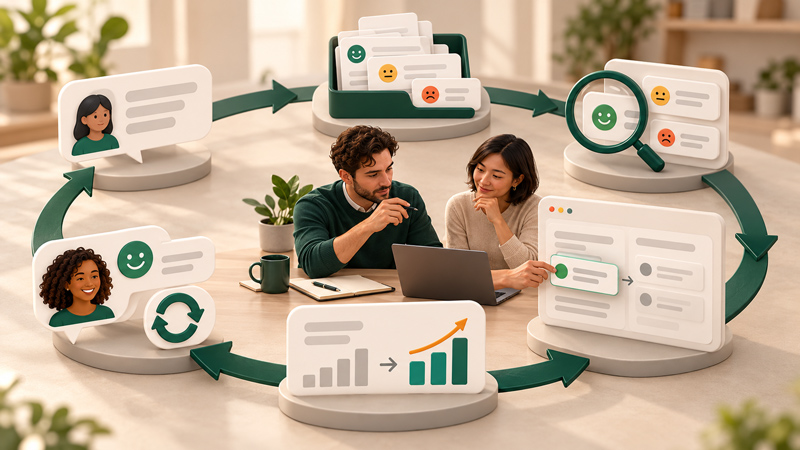
A customer learning loop is a repeatable process:
Ask → Collect → Analyze → Act → Measure → Ask Again
The objective isn't simply to collect responses.
It is to turn customer feedback into better decisions.
For example:
You ask customers what frustrates them about your onboarding.
You discover that many struggle with the same step.
You change the onboarding experience.
You measure whether satisfaction improves.
Then you ask again.
That is learning.
Step 1: Identify the Decision
Don't begin with:
"We need a survey."
Begin with:
"What decision are we trying to make?"
Examples:
-
Should we launch this feature?
-
Why are customers cancelling?
-
Why aren't visitors converting?
-
Which product improvement matters most?
-
How satisfied are customers after onboarding?
-
Why are customers choosing competitors?
A clear decision creates a clear research objective.
Step 2: Ask the Right People
Not every customer needs every survey.
Segment your audience.
For example:
-
New customers
-
Long-term customers
-
Trial users
-
Customers who cancelled
-
High-value customers
-
Customers who contacted support
-
Customers who purchased a specific product
The more relevant the audience, the more useful the feedback.
Step 3: Ask Focused Questions
A common mistake is creating a 30-question survey because "we might as well ask everything."
Don't.
Long surveys create respondent fatigue and often produce lower-quality responses.
Ask what you need to make the decision.
For example:
How easy was it to get started?
Then:
What was the biggest challenge?
Then:
What would have made the process easier?
Three focused questions can be more useful than thirty unfocused ones.
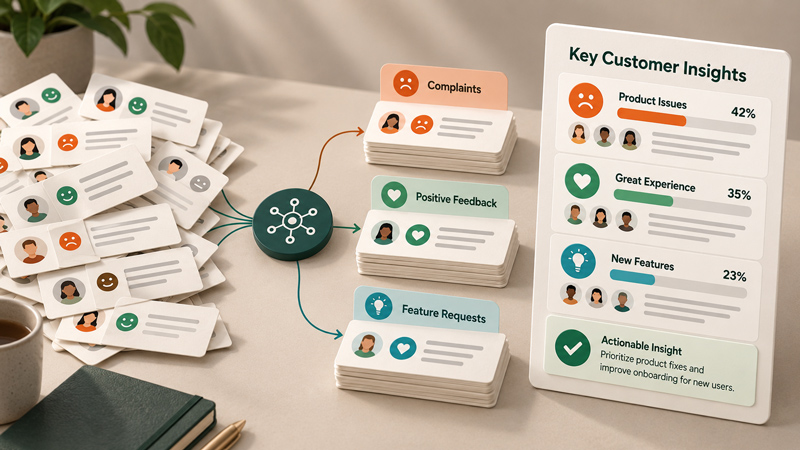
Step 4: Analyze the Responses
A feedback system needs an analysis layer.
Look for:
-
Trends
-
Outliers
-
Recurring problems
-
Differences between segments
-
Changes over time
-
Positive experiences
-
Negative experiences
Don't only look at the average.
An average score can hide important differences.
Step 5: Take Action
This is where many feedback programs fail.
They collect responses.
They produce a dashboard.
Then nothing changes.
Feedback only creates value when it influences action.
Turn findings into:
-
Product changes
-
Website improvements
-
Training
-
Support improvements
-
Marketing changes
-
New features
-
Process improvements
Step 6: Measure the Change
Suppose customers report:
"The onboarding process is confusing."
You simplify onboarding.
Now ask:
Did the experience improve?
Measure:
-
CSAT
-
CES
-
Completion rates
-
Support requests
-
Time to activation
You can now compare the before and after.
Step 7: Repeat
The loop closes when you ask again.
That creates a powerful cycle:
Feedback → change → measurement → feedback.
Over time, the company becomes better at understanding its customers.
Where Enquete Fits
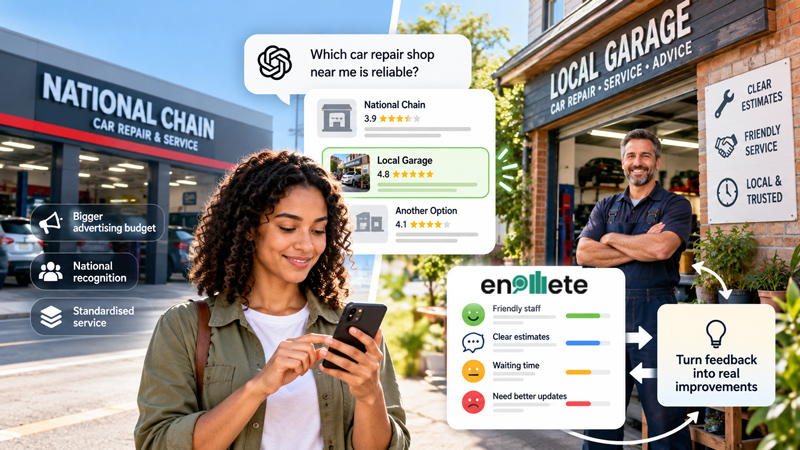
Enquete supports many of the building blocks required for this process, including recurring surveys, NPS/CSAT/CES, survey analytics, response filtering, trend reports, advanced filters and AI Insight.
You can distribute surveys through email, links, website pop-ups, widgets, iframes and other channels depending on your workflow.
This makes it possible to move from occasional feedback collection to an ongoing feedback program.
Don't Measure Everything
A learning loop doesn't mean surveying customers constantly.
It means asking the right question at the right moment.
A useful schedule might be:
After purchase: satisfaction
After onboarding: ease of use
After support: resolution quality
Quarterly: relationship/NPS feedback
Before major product decisions: customer research
After major changes: impact measurement
The goal is not more surveys.
The goal is more useful learning.
Your Feedback Program Should Influence the Business
The strongest feedback programs have a visible connection between:
Customer voice
and
Business decisions.
When product, marketing, customer success and leadership teams regularly use customer feedback, surveys stop being questionnaires.
They become part of the company's decision-making infrastructure.
The Customer Intelligence Series
- Why AI Makes Customer Feedback More Valuable, Not Less
- Stop Asking AI What Your Customers Want. Ask Your Customers.
- How to Build a Customer Learning Loop
- What Your Customers Do Isn't the Same as Why They Do It
- How to Turn Survey Responses Into Marketing Intelligence
- How Original Customer Research Can Make Your Brand More Visible in AI Search
- How to Use Customer Feedback to Improve Website Conversion
- How to Combine Behavioral Data With Customer Feedback
- Why More Marketing Data Doesn't Always Mean Better Decisions
- How to Turn Customer Surveys Into Original Research Reports