The timing of a survey influences the quality and meaning of every response it receives.
Organisations often focus heavily on writing the right questions but give far less attention to when those questions should be asked. A well-designed survey sent at the wrong moment can produce incomplete, distorted or misleading feedback.
A customer may receive a satisfaction survey several weeks after a purchase. A patient may be asked about an appointment long after the visit. A training participant may receive an evaluation after the details of the programme have faded. In each case, the respondent is no longer evaluating the original experience directly. They are reconstructing it from memory.
That distinction matters.
If you want to understand what someone experienced, the survey should usually be sent while the experience is still clear. If you want to understand whether an experience produced a lasting result, waiting may be necessary.
The best survey timing therefore depends on what you are trying to measure.
Survey timing changes what you measure
A survey sent immediately after an interaction captures a different kind of information from one sent several weeks later.
Immediate feedback is usually better for measuring details such as:
- Whether the process was easy
- Whether instructions were clear
- Whether an employee was helpful
- Whether the respondent encountered a problem
- How the respondent felt at the end of the interaction
- Whether the experience met their expectations
Delayed feedback may be more appropriate for measuring:
- Whether a product remained useful
- Whether a problem was permanently resolved
- Whether someone applied what they learned
- Whether behaviour changed
- Whether the respondent experienced longer-term results
- Whether initial satisfaction continued over time
Neither approach is automatically better. They answer different questions.
The problem arises when an organisation waits several weeks and then asks respondents to remember small details, or sends a survey immediately and uses the results as proof of a long-term outcome.
Good survey timing starts by defining the decision the feedback is expected to support.
Memory becomes less reliable over time
People do not store every detail of an experience accurately. They remember selected moments, general impressions and emotionally significant events.
As time passes, respondents may forget:
- The order in which events occurred
- How long individual steps took
- Which employee helped them
- What information they received
- Why they felt satisfied or dissatisfied
- The difference between one interaction and another
Later events can also change how the original experience is remembered.
A customer might initially be happy with a purchase but become dissatisfied when the product develops a problem. If surveyed later, the product failure may influence how the customer remembers the purchasing process, even if that process was originally smooth.
The opposite can also happen. A customer may experience a frustrating support interaction but feel more positive after the problem is eventually resolved. A later survey may capture the successful outcome while overlooking the earlier difficulties.
This does not make delayed feedback invalid. It means that delayed feedback reflects the respondent’s current interpretation of the experience rather than a precise record of the original moment.
Immediate surveys capture details but not every outcome
Sending a survey quickly reduces the burden on the respondent’s memory.
A customer who has just completed a purchase can usually remember whether the checkout process was confusing. A patient leaving a clinic can describe whether the instructions were clear. A participant completing a training session can assess the trainer, materials and relevance of the programme.
However, immediate surveys also have limitations.
A customer may not yet know whether the product meets their needs. A patient may not know whether the treatment was effective. A training participant may feel confident but may not yet have attempted to apply the learning at work.
An immediate survey is therefore suitable for measuring the experience, but it should not be treated as complete evidence of a long-term result.
For example, asking a participant at the end of a training session whether they intend to use a new skill can provide useful information about confidence and intention. It cannot prove that the participant actually used the skill later.
The wording and interpretation of the survey should reflect this limitation.
The right time depends on the customer journey
There is no universal best day or hour for every survey.
Generic advice such as “send surveys on Tuesday morning” focuses on open rates without considering the event being evaluated. A respondent may be more likely to open an email at a particular time, but that does not mean the survey was sent at the right point in the experience.
For transactional feedback, the most important timing signal is usually the event itself.
The survey should be connected to a meaningful moment in the customer or participant journey, such as:
- Completing a purchase
- Receiving a delivery
- Closing a support case
- Attending an event
- Completing a training session
- Visiting a clinic
- Using a product for a defined period
- Cancelling a subscription
- Completing an onboarding process
Event-based timing creates a clear relationship between the survey and the experience being measured.
The survey invitation can refer directly to the relevant interaction, making it easier for the respondent to understand what they are being asked to evaluate.
When to send a post-purchase survey
A post-purchase survey can measure several different stages of the buying experience.
If the objective is to evaluate checkout, payment or website usability, the survey should be presented immediately after the transaction or sent shortly afterwards. At that point, the customer can still remember where they hesitated, which steps were confusing and whether the payment process felt secure.
If the objective is to evaluate fulfilment or delivery, the survey should wait until the order has arrived. Asking about the complete purchase experience before delivery produces an incomplete result.
If the objective is to evaluate product satisfaction, the customer needs enough time to use the product. The appropriate delay may range from several days to several months, depending on what was purchased.
A survey about a restaurant order can be sent quickly. A survey about business software, professional equipment or a long-term service may need to wait until the customer has experienced meaningful use.
One purchase may therefore justify more than one carefully targeted survey. However, organisations must avoid asking too frequently. Every survey should have a clear purpose.
When to send a support survey
A support survey is usually most relevant after the interaction or case has been completed.
Sending it too early can create several problems. The customer may still be waiting for a solution, the issue may reopen or the organisation may measure the politeness of the support agent rather than whether the problem was resolved.
The best trigger is not always when an agent marks a ticket as closed. Some tickets are closed administratively even though the customer does not believe the problem has been solved.
A useful support survey can distinguish between:
- Satisfaction with the support interaction
- Ease of obtaining help
- Quality of communication
- Speed of the response
- Whether the issue was resolved
- Whether the solution continued to work
The first four can often be measured immediately. Confirming that the solution remained effective may require follow-up later.
For serious complaints or low satisfaction scores, the survey should also connect to a follow-up process. Collecting negative feedback quickly has little value if it remains unnoticed in a dashboard.
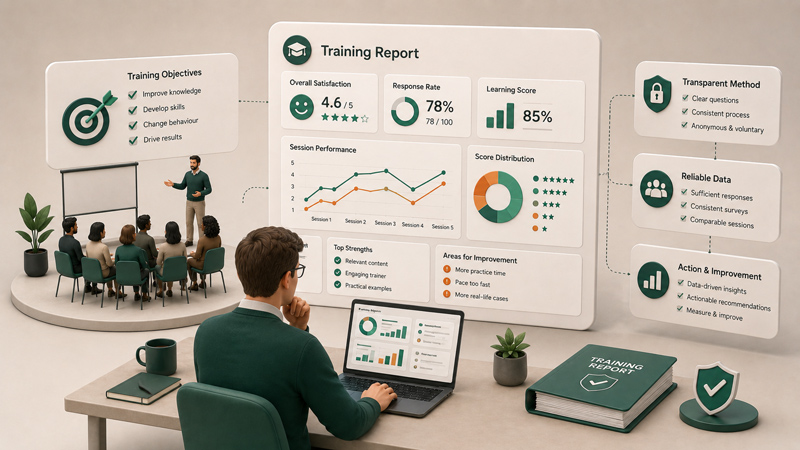
When to send a training survey
Training evaluation often requires multiple measurement points.
An immediate post-training survey can assess:
- Participant satisfaction
- Relevance of the content
- Quality of the trainer
- Clarity of the materials
- Confidence after the session
- Intended application of the learning
Learning can also be assessed immediately through a knowledge test, practical exercise or comparison with a pre-training assessment.
Behavioural change requires more time. Participants need an opportunity to return to their work and apply what they learned. A follow-up survey may therefore be sent several weeks or months after the programme, depending on the skill and workplace context.
The follow-up can investigate:
- Whether the participant applied the learning
- How frequently the new skill was used
- Which barriers prevented application
- Whether management provided support
- Whether additional training is needed
- Whether the change produced a useful result
Using the same immediate survey for both satisfaction and long-term effectiveness is a mistake. These outcomes exist on different timelines and should be measured accordingly.
When to send a patient feedback survey
Healthcare feedback requires particular care because the experience may be sensitive and the patient’s condition can influence their ability or willingness to respond.
A patient experience survey may be sent shortly after an appointment or discharge while the interaction is still clear. This can help evaluate communication, waiting time, dignity, clarity of instructions and the administrative process.
Questions about recovery, treatment effectiveness or longer-term outcomes may need to be asked later.
Sending the survey too soon may place an unnecessary burden on the patient. Waiting too long may reduce recall accuracy. The appropriate timing should consider the type of care, the seriousness of the condition and the purpose of the evaluation.
Privacy and consent must also be respected. Organisations should collect only the information necessary for the stated purpose and avoid including sensitive details unnecessarily in survey invitations.
Delayed surveys are necessary for long-term outcomes
Some of the most important outcomes cannot be measured immediately.
A new employee cannot properly evaluate an onboarding programme before beginning the job. A business customer cannot assess the value of software before using it. A training participant cannot confirm workplace application before returning to work.
In these situations, delay is not a weakness. It is part of the evaluation design.
The important question is whether the survey asks the respondent to evaluate something they can reasonably know at that point.
A delayed survey should focus on current outcomes rather than forcing the respondent to reconstruct minor details from the past. For example, it is more reliable to ask how frequently a participant now uses a skill than to ask them to remember exactly how they felt during a training session months earlier.
Avoid sending surveys at moments of friction
Even when feedback is relevant, the invitation should not interrupt a critical task.
A survey that appears before a customer has completed payment can distract from the transaction. A pop-up shown while someone is trying to solve a problem can increase frustration. A survey sent repeatedly while a complaint is unresolved can make the organisation appear disconnected.
Good timing considers both measurement quality and respondent experience.
Before triggering a survey, ask:
- Has the relevant interaction been completed?
- Does the respondent have enough information to answer?
- Is the survey interrupting something more important?
- Has this person recently received another survey?
- Can the organisation act on the feedback?
- Is this an appropriate moment for a sensitive question?
A survey should feel like a logical continuation of the experience, not an unrelated demand.
Survey reminders also require careful timing
A reminder can increase response rates, but excessive reminders damage trust.
The respondent should have enough time to see and complete the original invitation. Sending a reminder within a few hours may feel impatient. Waiting several weeks may make the feedback less reliable.
The appropriate interval depends on the urgency and lifespan of the survey.
A short transactional survey may justify one reminder after a few days. A longer research survey may remain open for several weeks and use a different reminder schedule.
Reminders should stop automatically after the respondent completes the survey. Sending another invitation after completion signals poor administration and can weaken confidence in the organisation’s feedback process.
Automation improves timing, but rules still matter
Manual survey distribution depends on people remembering when to send each invitation.
This becomes unreliable when an organisation manages many customers, support cases, training sessions or patient visits. Invitations may be delayed, forgotten or sent inconsistently.
Automation allows surveys to be triggered by relevant events. For example:
- A completed purchase triggers a checkout survey
- A delivered order triggers a fulfilment survey
- A closed support case triggers a service survey
- A completed training session triggers an evaluation
- A defined delay triggers a follow-up survey
- A low score triggers an internal notification
However, automation should not mean sending more surveys indiscriminately.
Rules are needed to prevent duplicate invitations, exclude inappropriate cases, respect survey frequency limits and stop reminders after completion.
The purpose of automation is to improve consistency and relevance—not to maximise the number of messages sent.
How Enquete supports better-timed feedback
Enquete helps organisations distribute surveys at relevant stages of the respondent journey.
Depending on the workflow, surveys can be shared through links, email campaigns, embedded questions, QR codes, kiosk devices or integrations with other business systems. Recurring surveys and automated workflows can reduce reliance on manual administration.
Zapier integrations and webhooks can also connect survey activity to external events and applications. This allows organisations to build workflows in which the appropriate survey or follow-up action is triggered at the right moment.
The technology provides the mechanism, but the organisation still needs a sound timing strategy. A perfectly automated survey sent at the wrong moment will consistently collect the wrong type of feedback.
Measure what the respondent can genuinely evaluate
The best survey timing is not simply the moment that generates the highest response rate.
It is the moment when the respondent can provide the type of information the organisation actually needs.
Send surveys quickly when you need accurate details about an experience. Wait when you need evidence of product use, behavioural change or longer-term results. When both perspectives matter, use separate measurement points with clearly defined purposes.
The goal is not to ask respondents to remember everything.
It is to ask the right question while they are in the best position to answer it.
Use Enquete to create surveys, automate distribution and collect feedback at the moments that matter.