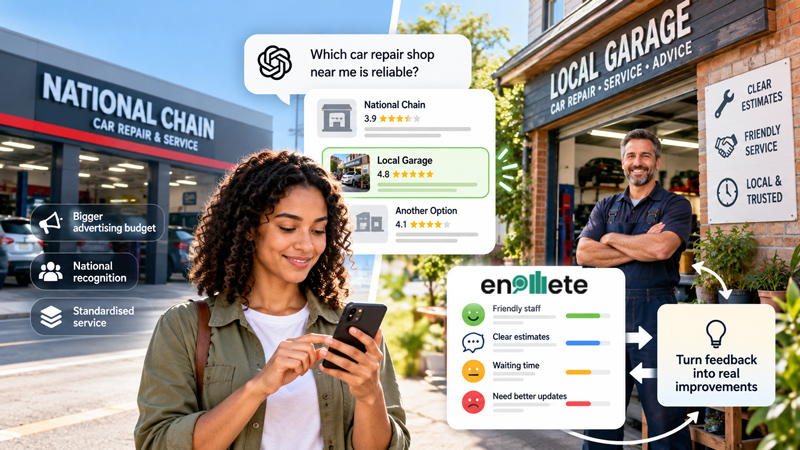
Artificial intelligence has changed how quickly companies can create content, analyze information, generate ideas, personalize communication, and automate marketing.
That sounds like it should make customer feedback less important.
The opposite may be true.
As AI makes execution faster and cheaper, understanding what customers actually think becomes increasingly valuable.
The problem businesses face is no longer simply:
"Can we create this?"
It is increasingly:
"Should we create this in the first place?"
That is where customer intelligence matters.
AI Can Help You Execute. It Can't Become Your Customer.
Give an AI tool a product description and it can produce dozens of marketing messages.
Give it a topic and it can generate articles.
Give it a campaign objective and it can suggest audiences, headlines, emails, and creative concepts.
But there is an important limitation.
AI can process enormous amounts of information, but it does not automatically know what your customers specifically want, fear, value, dislike, or expect.
You can ask an AI:
"What do customers usually want from a survey platform?"
It can give you a reasonable answer.
But that answer is not the same as asking 500 of your actual customers.
Your customers might tell you something completely different.
Perhaps they care less about advanced analytics than you assumed. Perhaps their biggest frustration is distributing surveys. Perhaps they need better reporting for management. Perhaps they love a feature your marketing barely mentions.
Those insights are valuable precisely because they come from your customers.
Execution Is Becoming Commoditized
As AI tools become more capable, businesses gain access to similar capabilities.
Your competitors can also:
-
Generate marketing copy.
-
Create images and videos.
-
Analyze campaign performance.
-
Automate email sequences.
-
Generate product ideas.
-
Build landing-page variations.
-
Summarize customer conversations.
The availability of these capabilities changes the source of competitive advantage.
If everyone can execute faster, knowing what deserves to be executed becomes more important.
Customer feedback can provide that missing layer.
Feedback Creates a Proprietary Information Loop
Consider two companies.
Company A relies primarily on:
-
Industry reports
-
Competitor research
-
Search trends
-
AI-generated recommendations
-
Internal assumptions
Company B combines those sources with continuous feedback from its own customers.
Company B can ask:
-
Why did you choose us?
-
What almost stopped you from buying?
-
Which feature is most valuable?
-
What problem are you trying to solve?
-
What would make our product more useful?
-
How likely are you to recommend us?
-
What should we improve?
The answers become proprietary customer intelligence.
Competitors may have access to the same public market data.
They don't have access to your customers' answers.
The New Marketing Loop
This creates a different way of thinking about marketing.
Instead of:
Research → Create → Publish → Move on
build:
Ask → Learn → Decide → Execute → Measure → Ask Again
The first step is especially important.
If your assumptions are wrong, better execution simply helps you execute the wrong idea faster.
Don't Use AI Instead of Customer Research
There is a temptation to ask AI what customers want and then use the answer as a substitute for research.
That is backwards.
A stronger process is:
Customers provide the evidence.
AI helps you process the evidence.
Your team makes the decision.
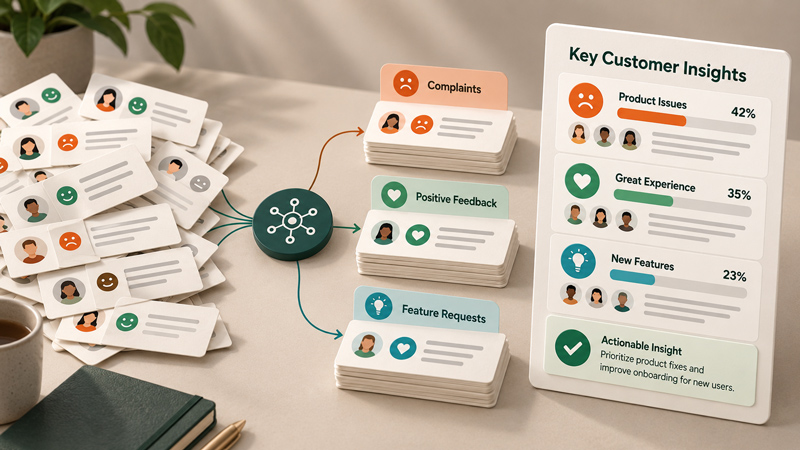
For example, you could collect hundreds of open-ended customer responses and use AI-assisted analysis to identify recurring themes.
Instead of manually reading every response, your team can quickly identify:
-
Common complaints
-
Repeated requests
-
Positive themes
-
Emerging problems
-
Differences between customer segments
-
Potential product opportunities
This is where AI becomes extremely useful.
It doesn't replace the customer voice.
It helps you understand it faster.
Build a Continuous Feedback System
Customer feedback shouldn't necessarily be a once-a-year activity.
Different moments require different questions.
After purchase:
How satisfied are you with your purchase?
After onboarding:
How easy was it to get started?
After support:
Did we resolve your issue?
Before launching a product:
Which problem is most important to you?
After releasing a feature:
How useful is this feature?
At renewal:
What is the primary reason you continue using our product?
These individual surveys can become a continuous customer-learning system.
How Enquete Can Help
Enquete provides the infrastructure for collecting and analyzing this feedback.
You can create surveys using different question types, including NPS, CSAT and CES, distribute them through links, email, website widgets, pop-ups and embeds, and analyze responses using survey analytics, filters, trend reports and AI Insight. Enquete also supports recurring surveys, making continuous feedback easier to operationalize.
The important point isn't the survey itself.
The important point is what you do with the information afterward.
The Real AI Advantage
AI gives businesses more ability to act.
Customer intelligence gives them better information about what to act on.
The companies that combine the two can create a powerful loop:
Real customer feedback → better understanding → better decisions → faster execution → measurable results → more feedback.
AI doesn't make customer feedback obsolete.
It can make the feedback you already collect significantly more useful.
The Customer Intelligence Series
- Why AI Makes Customer Feedback More Valuable, Not Less
- Stop Asking AI What Your Customers Want. Ask Your Customers.
- How to Build a Customer Learning Loop
- What Your Customers Do Isn't the Same as Why They Do It
- How to Turn Survey Responses Into Marketing Intelligence
- How Original Customer Research Can Make Your Brand More Visible in AI Search
- How to Use Customer Feedback to Improve Website Conversion
- How to Combine Behavioral Data With Customer Feedback
- Why More Marketing Data Doesn't Always Mean Better Decisions
- How to Turn Customer Surveys Into Original Research Reports