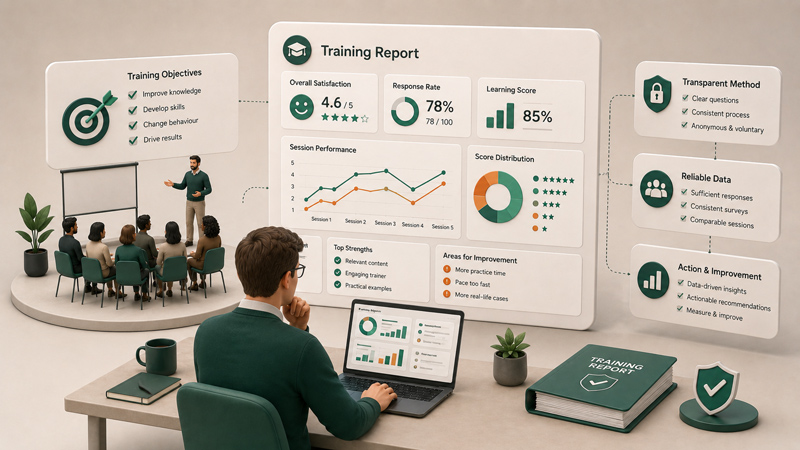
A survey dashboard can show average scores, response trends, satisfaction levels and recurring themes.
It can tell you that customer satisfaction declined last month. It can show that one training session received weaker ratings than the others. It can reveal that employees are unhappy with communication or that patients consistently report long waiting times.
But a dashboard cannot improve any of those situations on its own.
It organises information. It does not decide what matters, assign responsibility, change a process or verify that an improvement worked.
Many feedback programmes become trapped at this stage. The organisation collects responses, builds attractive charts and discusses the results—but nothing operational changes.
The dashboard becomes the final destination of the feedback when it should have been the beginning of an improvement workflow.
Visibility is not the same as action
Dashboards solve a genuine problem: they make large volumes of feedback easier to understand.
Without visual reporting, teams may have to read individual responses, calculate figures manually or work through spreadsheets. A dashboard can quickly reveal patterns that would otherwise remain hidden.
However, seeing a problem does not resolve it.
A customer experience dashboard may show that delivery satisfaction is falling. Unless someone investigates why, decides what to change and takes responsibility for the change, the score will remain a visual description of the problem.
This is where many organisations confuse insight with impact.
An insight is something the organisation has learned. Impact occurs when that learning leads to a decision, an action and a measurable result.
Feedback often has no clear owner
One of the main reasons survey findings remain unused is unclear ownership.
A team receives a report showing several problems, but no one knows who is responsible for addressing them.
Customer service may believe the problem belongs to operations. Operations may believe it belongs to product management. Product management may believe the issue is caused by poor communication. Everyone can see the result, but no one owns the response.
Every important finding needs a person or team responsible for deciding what happens next.
Ownership does not mean that one person must solve the entire problem. It means that someone is accountable for moving the issue forward.
Without ownership, feedback becomes everybody’s concern and nobody’s responsibility.
Not every finding deserves the same response
A dashboard may display hundreds of comments and dozens of metrics.
Attempting to act on everything at once creates confusion. Teams become overwhelmed, minor issues compete with serious ones and improvement efforts lose focus.
Feedback needs to be prioritised.
Useful prioritisation criteria include:
- Severity of the issue
- Number of people affected
- Frequency of occurrence
- Risk to customers, employees or patients
- Relationship to strategic objectives
- Cost of leaving the issue unresolved
- Effort required to improve it
- Confidence in the available evidence
A single serious safety complaint may require immediate attention even if it does not represent a trend. A recurring minor usability complaint may justify a product improvement because it affects many customers.
Prioritisation requires judgement. A dashboard can support that judgement, but it cannot replace it.
Average scores can hide actionable problems
Dashboards often place averages at the centre of reporting.
A customer satisfaction score of 4.2 out of 5 may appear healthy. But the average may hide a small group of customers experiencing a severe problem.
Similarly, an overall training score may remain high while participants consistently rate one specific module poorly. An employee engagement score may look stable even though one department has experienced a significant decline.
Teams need to look beyond headline metrics and investigate:
- Response distributions
- Differences between groups
- Sudden changes
- Recurring comments
- Outliers
- Low-score categories
- Changes after operational events
- Areas with low response rates
The purpose of analysis is not to admire the score. It is to identify where intervention may be necessary.
Open-text feedback requires interpretation
Written comments often contain the most actionable information in a survey.
A score may show that someone was dissatisfied. A comment can explain that the customer waited ten days for an answer, received contradictory information and had to contact support three times.
However, open-text feedback is also messy.
Respondents may discuss several issues in one comment. They may use different language to describe the same problem. Some comments are vague, emotional or unrelated to the question.
Turning written feedback into action requires teams to:
- Identify recurring themes
- Separate symptoms from underlying causes
- Distinguish isolated incidents from patterns
- Evaluate the seriousness of specific comments
- Connect themes to responsible teams
- Determine whether more information is required
AI-assisted analysis can accelerate the identification of themes, but human judgement remains necessary. An automated summary may miss organisational context, misunderstand sarcasm or give equal importance to issues with very different consequences.
The goal is to use automation to reduce processing time while keeping people responsible for interpretation and decisions.
Low scores need operational workflows
A low survey score is not an outcome. It is a signal that something may require attention.
If a dissatisfied customer submits a response and the result remains inside a dashboard for several days, the feedback process is slow even if the survey was delivered immediately.
Important responses should be routed to the people who can act.
Depending on the context, a low score might trigger:
- A customer-service follow-up
- An internal support ticket
- A notification to a manager
- A quality review
- An investigation
- A request for additional information
- A product issue
- A patient-safety escalation
Not every negative score should generate an urgent alert. Excessive notifications create alert fatigue, and teams eventually begin ignoring them.
Workflow rules should distinguish between ordinary dissatisfaction, recurring problems and serious risks.
Collecting feedback creates an obligation to respond responsibly
When organisations ask for feedback, they create an expectation that the information will be considered.
Respondents invest time and may disclose frustrations, problems or sensitive experiences. If the organisation repeatedly asks for feedback but never communicates or demonstrates improvement, participation can decline.
People begin to believe that the surveys are performative.
This does not mean that every suggestion must be implemented. Respondents may request conflicting changes, propose impractical solutions or misunderstand organisational constraints.
But every feedback programme should have a clear process for reviewing, prioritising and responding to the information collected.
Organisations should be able to explain:
- Who reviews the feedback
- How serious issues are escalated
- How priorities are selected
- How decisions are documented
- How respondents are informed
- How improvements are evaluated
Without this process, collecting more responses simply creates a larger backlog of neglected information.
Action plans need specific commitments
Statements such as “improve communication” or “provide better service” are not actionable plans.
A useful action plan should define:
- The problem being addressed
- The evidence supporting the problem
- The intended change
- The responsible owner
- The completion date
- The resources required
- The measure of success
- The review date
For example, suppose feedback shows that customers frequently contact support because onboarding emails do not explain how to configure an important feature.
A weak action would be:
Improve onboarding communication.
A stronger action would be:
Update the third onboarding email to include setup instructions and a link to the relevant documentation. The content manager owns the change, which should be completed before the next campaign cycle. Compare related support requests during the four weeks before and after the update.
The second version makes responsibility and measurement explicit.
Root causes matter more than symptoms
Survey feedback often describes symptoms rather than underlying causes.
Customers may report slow support. The real cause could be unclear documentation, repeated product failures, poor ticket routing or insufficient staffing.
Employees may report excessive workload. The cause could be inefficient approval processes, unclear priorities, vacant positions or recurring rework.
Training participants may report that a programme felt rushed. The cause could be too much content, insufficient preparation, late arrival of participants or excessive time spent on one section.
Acting only on the visible symptom can produce superficial improvements.
Root-cause analysis may involve:
- Reviewing operational data
- Interviewing employees
- Examining process steps
- Comparing different respondent groups
- Analysing repeated comments
- Testing assumptions
- Observing the actual experience
Survey data identifies where to look. It does not always explain the complete cause.
Feedback should be connected to other business information
Survey responses become more useful when interpreted alongside operational data.
A declining satisfaction score may become clearer when connected to:
- Delivery delays
- Support response times
- Product defects
- Employee turnover
- Training attendance
- Website errors
- Complaint categories
- Subscription cancellations
This does not mean that every response should be connected to extensive personal data. Privacy, consent and data-minimisation requirements still apply.
The purpose is to understand whether feedback patterns correspond with real events and outcomes.
For example, if satisfaction declined during the same period that delivery times increased, the organisation has a stronger lead for investigation. If scores improved after a process change, the organisation can examine whether the change contributed to the improvement.
Close the loop with respondents
Closing the feedback loop means communicating what happened after feedback was collected.
This may involve:
- Contacting an individual respondent about a problem
- Publishing a summary of the findings
- Explaining which improvements will be made
- Clarifying why a requested change is not possible
- Reporting progress later
- Asking whether the improvement solved the problem
Closing the loop helps respondents see that their participation had value.
Individual follow-up is appropriate when the respondent is identifiable and has requested or reasonably expects a response. Broader communication is useful for anonymous surveys or organisation-wide research.
The message does not need to claim that every issue has been solved. Honest updates are more credible than vague statements about “listening to feedback.”
Measurement should continue after the change
Many improvement programmes stop after an action has been implemented.
A company updates a process, delivers additional training or changes a product feature and assumes that the problem has been solved.
But implementation is not proof of improvement.
The organisation should measure what happened afterwards.
Useful follow-up questions include:
- Did the relevant survey score improve?
- Did negative comments on the issue decline?
- Did operational performance change?
- Did the improvement create new problems?
- Was the result consistent across groups?
- Did respondents notice the difference?
- Should the change be retained, adjusted or reversed?
This creates a complete feedback loop:
- Collect the signal.
- Understand the problem.
- Assign ownership.
- Take action.
- Measure the result.
- Improve again.
Without the final measurement, the organisation knows that something changed but not whether it worked.
Dashboards should support decisions, not decorate reports
A useful dashboard should help users identify where attention is required.
That means showing more than visually attractive charts. It should provide enough context to support investigation and action.
Depending on the survey, a decision-focused dashboard may include:
- Current scores and trends
- Response counts and rates
- Comparisons between groups or periods
- Distribution of responses
- Common themes
- Critical comments
- Filters for relevant segments
- Links to individual responses where appropriate
- Indicators showing significant changes
The dashboard should be designed around the decisions its users need to make.
Adding more charts does not automatically create more value. A crowded dashboard can obscure the few findings that genuinely require attention.
Integrations connect feedback to operations
Survey integrations can help move important information beyond the dashboard.
For example, a completed response can:
- Create a task in a project-management system
- Add information to a CRM
- Update a spreadsheet
- Notify a responsible team
- Open a support case
- Trigger a follow-up email
- Send data to an internal application
Zapier can support no-code workflows with many popular business tools. Webhooks provide more control when organisations need custom applications, validation rules or complex business logic.
The correct approach depends on the workflow.
Simple automation is often sufficient for routing routine feedback. Business-critical workflows may require stronger monitoring, security controls, error handling and technical oversight.
The objective is not to automate every response. It is to reduce the delay between receiving meaningful feedback and starting the appropriate action.
How Enquete supports the feedback workflow
Enquete helps organisations collect, analyse and route survey responses.
Dashboards and reports make response patterns easier to understand. Filters and analytical features support deeper investigation. AI-assisted insights can accelerate the processing of larger response sets.
Enquete’s Zapier integration and webhooks can connect feedback to other systems, allowing completed responses or important events to trigger operational workflows.
These capabilities support a stronger feedback process, but technology alone cannot create accountability.
Organisations still need to decide:
- Which feedback matters
- Who owns each issue
- What action should be taken
- How quickly teams should respond
- How success will be measured
Enquete can move the signal to the right place. The organisation must still make the decision and carry out the improvement.
The survey is the beginning
The purpose of a survey is not to produce a dashboard.
The purpose is to learn something that helps the organisation make a better decision.
Dashboards are valuable because they make feedback visible. But visibility without ownership, action and follow-up measurement does not create change.
A mature feedback programme does not stop when the responses arrive. It turns those responses into a repeatable operational cycle:
Collect. Understand. Prioritise. Assign. Act. Measure again.
That is how feedback becomes improvement rather than another report that people review and forget.
Use Enquete to collect feedback, analyse responses and connect important survey results to the workflows where action happens.